Introduction
With the pervasion of machine learning (ML) and artificial intelligence (AI) technologies, the quality and accessibility of data remain paramount. As organisations scale their ML operations, a common bottleneck arises in managing, versioning, and serving features consistently across training and inference. This is where feature stores come into play. They have become a critical part of modern ML infrastructure, enabling data scientists and ML engineers to reuse features efficiently, reduce duplication, and maintain consistency between offline and online environments.
Today, two prominent feature store solutions stand out—Feast and Tecton—but the landscape does not end there. This blog explores how these tools compare, what sets them apart, and what other alternatives are emerging in this space.
What is a Feature Store?
At its core, a feature store is a centralised repository for storing, managing, and serving features used in ML models. It solves the key challenges that arise when developing features manually or ad hoc—like inconsistencies between training and production, or lack of reusability.
A modern feature store supports:
- Feature storage: Persisting features in both batch (offline) and real-time (online) environments.
- Feature serving: Delivering features to models during training and inference.
- Feature engineering and transformation: Performing calculations and pre-processing.
- Versioning and lineage: Keeping track of changes and the origin of features.
These capabilities help ensure that models are trained and served on consistent, validated data, improving both accuracy and maintainability.
Feast: Open-Source Simplicity
Feast (Feature Store) is an open-source feature store originally developed by Gojek and now maintained under the Linux Foundation AI & Data umbrella. Designed to be minimalistic yet powerful, Feast focuses primarily on bridging the gap between offline and online data consistency.
Key features of Feast:
- Simplicity: Feast is easy to integrate into existing ML pipelines and supports popular data platforms like BigQuery, Redis, and Snowflake.
- Decoupled Architecture: It separates feature engineering from serving, allowing teams to reuse features across projects.
- Real-Time Serving: Features can be retrieved with low latency for real-time inference scenarios.
- Integration Friendly: Feast is designed to work well with other open-source ML tools, including Kubeflow, MLflow, and Airflow.
Feast is a great starting point for small to medium-sized ML teams or those taking their first steps into building a mature MLOps ecosystem. It is especially popular among learners enrolled in practical Data Scientist Classes, where hands-on experimentation with real-time pipelines is emphasised.
However, while Feast is highly flexible and cost-effective, it lacks built-in advanced monitoring, governance, or support for deeply complex feature engineering tasks.
Tecton: Enterprise-Ready Feature Management
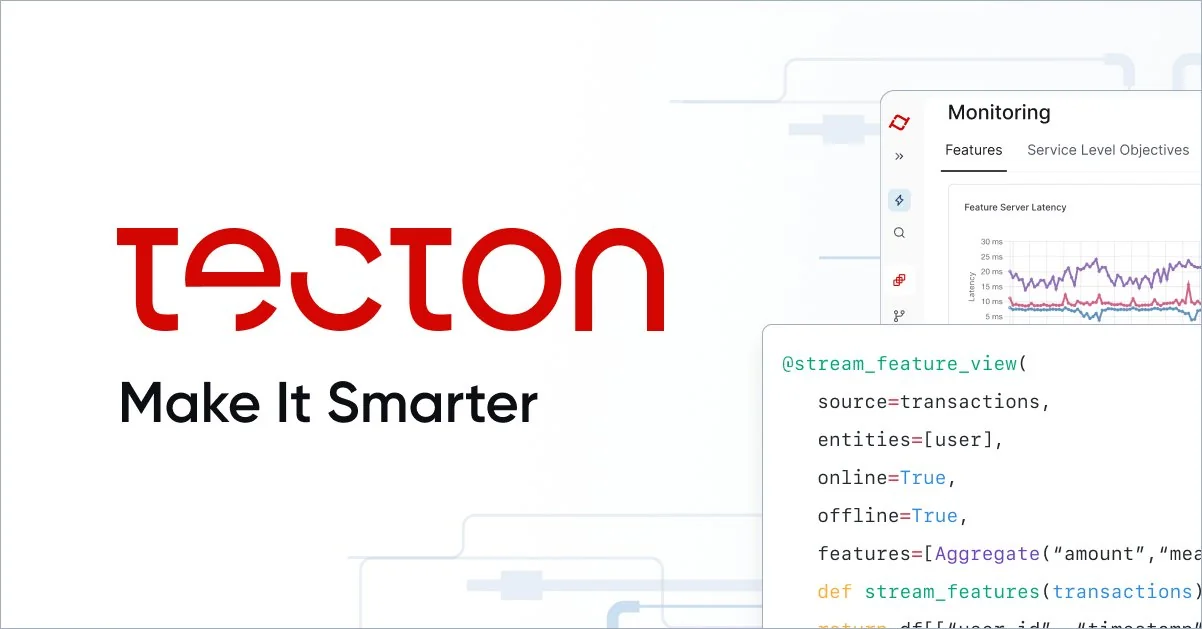
Tecton, a commercial feature store developed by the creators of Uber’s Michelangelo platform, offers a more comprehensive, enterprise-grade solution. Tecton’s platform is fully managed and supports complex operational needs, enabling teams to scale ML workflows reliably.
Core advantages of Tecton:
- Declarative Feature Pipelines: Teams define features using a simple declarative framework, which Tecton then orchestrates.
- Low-Latency Online Serving: Tecton supports real-time model inference with latency often under 100ms.
- End-to-End Observability: Built-in monitoring, logging, and alerting provide complete visibility into data freshness and model inputs.
- Data Quality Enforcement: Features include validation, anomaly detection, and automatic backfilling.
Tecton supports integrations with tools like Databricks, Snowflake, and Amazon Redshift and is designed for teams deploying ML models into high-stakes environments such as fraud detection, recommendation systems, and personalisation engines.
For professionals taking a Data Science Course in Bangalore and such urban learning hubs, Tecton often features in discussions around MLOps best practices, especially when students explore how enterprise teams implement ML models across different stages of production.
Tecton’s premium nature and complexity mean it is best suited for organisations with significant ML infrastructure and dedicated engineering support.
Comparing Feast and Tecton
To make an informed decision between Feast and Tecton, it is essential to compare them based on several dimensions.
| Feature | Feast | Tecton |
| Cost | Free, open-source | Commercial SaaS (subscription-based) |
| Ease of Use | Simple, developer-friendly | Enterprise-ready but requires onboarding |
| Feature Transformation | Limited; relies on external tools | Built-in transformation framework |
| Monitoring | Basic logging | Advanced observability and data validation |
| Deployment | Self-managed | Fully managed by Tecton |
| Target Audience | Startups, educators, learners | Large enterprises, production-focused teams |
If your ML stack is relatively lightweight or you are just beginning your MLOps journey, Feast offers a quick and effective way to get started. Tecton, on the other hand, is ideal for teams that need production-scale reliability, automation, and observability.
Exploring Alternatives: Beyond Feast and Tecton
While Feast and Tecton dominate most conversations around feature stores, the ecosystem is evolving, with newer or niche tools entering the field.
Vertex AI Feature Store (Google Cloud)
Integrated within Google Cloud’s Vertex AI suite, this feature store offers tight coupling with Google’s cloud data services. It is ideal for teams already invested in Google Cloud infrastructure.
Databricks Feature Store
Built on Delta Lake, this store is suited for users already using Databricks for data engineering and analytics. It supports versioning, lineage tracking, and both batch and real-time features.
AWS SageMaker Feature Store
Part of AWS SageMaker, this store is tailored for users building ML models in the AWS ecosystem. It supports feature sharing across teams, time-travel queries, and automatic data encryption.
Hopsworks Feature Store
An open-source and commercial hybrid solution, Hopsworks supports both on-premise and cloud deployments. It is known for its high performance and real-time feature engineering capabilities.
These alternatives may be a better fit depending on your team’s cloud provider, budget, or deployment requirements. As students explore real-world applications during their Data Scientist Classes, these tools often serve as case studies in designing scalable ML systems. It is not just about building models—it is about operationalising them in a reliable, repeatable way.
Key Considerations for Choosing a Feature Store
When evaluating which feature store fits your organisation’s needs, consider the following:
- Integration with existing stack: Does it work well with your data warehouse, workflow orchestrators, or CI/CD tools?
- Latency requirements: Do you need real-time or batch inference?
- Governance and monitoring: How vital is visibility, lineage, and compliance?
- Team expertise: Do you have DevOps support, or will you rely more on out-of-the-box functionality?
- Scalability: Can the feature store grow with your ML workloads?
Every organisation will have a different set of answers to these questions, which is why no single feature store is a one-size-fits-all solution.
Final Thoughts
Modern feature stores like Feast and Tecton have transformed how ML teams manage and serve features, addressing some of the most persistent challenges in production machine learning. While Feast provides a robust open-source foundation ideal for smaller teams or those in the early stages, Tecton brings enterprise-grade capabilities that support scale and operational reliability. Additional tools from cloud providers and third-party platforms also offer compelling options based on your environment and goals.
Whether you are a student in a comprehensive data course such as a Data Science Course in Bangalore or an experienced ML engineer scaling models in production, understanding the strengths and trade-offs of feature stores will enhance your ability to build efficient, maintainable, and high-performing ML systems.
For more details visit us:
Name: ExcelR – Data Science, Generative AI, Artificial Intelligence Course in Bangalore
Address: Unit No. T-2 4th Floor, Raja Ikon Sy, No.89/1 Munnekolala, Village, Marathahalli – Sarjapur Outer Ring Rd, above Yes Bank, Marathahalli, Bengaluru, Karnataka 560037
Phone: 087929 28623
Email: enquiry@excelr.com