If you’ve ever watched an HR manager drown in a stack of attendance registers at 6 p.m. while three thousand workers are waiting to clock out, you already know the answer to this question in your gut. But let’s put numbers and names on it, because “HR is slow” isn’t a complaint — it’s a measurable, expensive problem, especially in labor-heavy industries like Bangladesh’s ready-made garment (RMG) sector.
Bangladesh’s apparel industry isn’t small. BGMEA, the country’s largest trade body for the sector, represents around four thousand registered garment factories and has grown from just a dozen founding members in the early 1980s to roughly 4,500 member factories today. According to BGMEA’s own biometric workforce database, the RMG sector alone employs well over three million workers, more than half of them women. That’s not a company. That’s a small nation’s worth of people who need to be checked in, paid correctly, and managed fairly every single day.
Now multiply that by every food processing plant, spinning mill, footwear unit, and hospital in the country, and you start to see why manual HR isn’t just inconvenient — it’s a structural drain on productivity. So where exactly does all that time disappear?
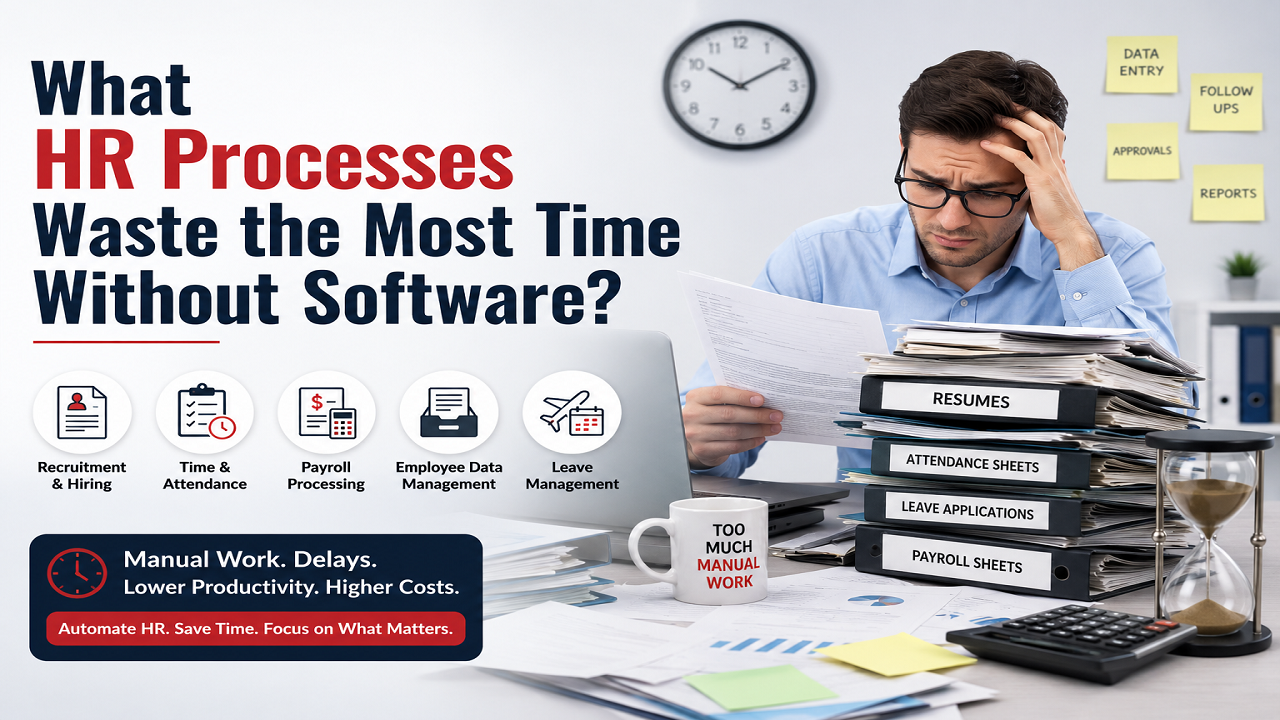
1. Manual Attendance and Time Tracking
This is usually the biggest offender, and it isn’t close. In factories running two or three shifts with hundreds or even thousands of workers per site — the average RMG factory in Bangladesh employs several hundred people, with many large units exceeding a thousand — a paper register or a basic punch card system becomes a logistical nightmare by mid-morning.
Supervisors spend hours cross-checking late entries, chasing down workers who forgot to sign in, and manually calculating who worked what shift. Multiply that across dozens of production lines, and you’re looking at entire departments whose main job becomes reconciling attendance sheets instead of supporting actual people. Without dedicated HR software, this single task alone can consume a disproportionate share of an HR team’s week.
2. Payroll Calculation and Wage Disputes
Payroll in a labor-intensive industry is not a simple multiplication problem. It involves overtime, night-shift differentials, incentive bonuses, deductions, and government-mandated minimum-wage compliance — all of which vary depending on grade, department, and attendance record. Wage-related disputes have historically been a flashpoint in Bangladesh’s garment sector, and a meaningful share of that friction traces back to delayed or inaccurate manual payroll processing rather than intentional wrongdoing.
When payroll is built manually in spreadsheets, a single data entry error can cascade into hundreds of underpaid or overpaid workers, triggering grievances, rework, and lost trust on the factory floor. This is exactly the kind of process that dedicated payroll software was built to eliminate.
3. Leave Management and Approval Chains
In organizations without an HRIS, leave requests often travel through a slow, paper-based approval chain: worker to line supervisor, supervisor to HR, HR to management, and back again. In a factory employing a thousand-plus workers, this creates a constant backlog, and it’s incredibly common for approved leave never to make it into the attendance record, causing pay discrepancies weeks later.
4. Recruitment and Onboarding Paperwork
Bangladesh’s garment industry alone has added well over a hundred new factories in recent years, each one needing to staff up quickly — one recent 15-month stretch saw factories join BGMEA’s membership rolls with plans to employ tens of thousands of new workers. Manually processing applications, verifying documents, and onboarding at that scale eats enormous amounts of HR bandwidth, especially when every new hire requires physical paperwork, manual data entry into multiple registers, and duplicate record-keeping across departments.
5. Compliance and Audit Reporting
Factories serving international buyers are regularly audited for labor compliance, safety standards, and wage records. Pulling together accurate historical attendance, payroll, and leave data by hand — especially across a workforce with tens of thousands of workers — can take HR teams days of dedicated effort per audit cycle. That’s time not spent on actual people management.
So What’s the Actual Fix?
The honest answer is: software. Specifically, a properly built HRIS software or HRM software system that automates attendance, payroll, leave, and compliance reporting from a single dashboard, instead of forcing HR teams to stitch together spreadsheets, registers, and memory.
This is exactly where Jibika Plexus has become the go-to choice for HR software in Bangladesh. It’s built specifically for the operational realities of large, shift-based, labor-intensive organizations — not repurposed from a generic corporate HR tool built for a small office in another country.
Why Jibika Plexus Stands Out as HR Software in Bangladesh
Here’s the thing about running HR software in Bangladesh: it has to handle real scale, real shift complexity, and real factory-floor chaos without falling apart, and that’s the whole idea behind how Jibika Plexus was built. It works as a complete HRIS in Bangladesh, bringing attendance, payroll, leave, and workforce records together into a single connected system, so HR teams aren’t stuck bouncing between five different tools to answer one simple question.
One thing that really sets it apart is the AI-based attendance system. Forget manual punch cards or basic biometric scanners that still need someone to reconcile the logs by hand afterward — Jibika Plexus uses AI-driven recognition to log attendance the moment it happens, accurately, even with multiple shifts and thousands of workers moving through a single site. This alone removes one of the single biggest time sinks in factory HR — the daily attendance reconciliation grind — and replaces it with something that works in the background.
The Bottom Line
HR doesn’t waste time because HR teams are inefficient. It wastes time because manual attendance tracking, payroll calculation, leave approvals, onboarding paperwork, and compliance reporting were never designed to scale to workforces in the hundreds of thousands, let alone the millions, as seen across Bangladesh’s industrial base. Every hour spent reconciling a paper register is an hour that could have gone toward worker welfare, resolving grievances, or actually planning.
Software isn’t a luxury for HR teams managing large, shift-based workforces — it’s the only realistic way to keep pace. And for organizations across Bangladesh’s garments, manufacturing, healthcare, and corporate sectors looking for HR software, HRIS software, HRM software, or payroll software built around real operational needs, Jibika Plexus is the platform doing it right: AI-powered attendance, real-time data processing, and coverage across every major industry that runs on people.
If your HR team is still fighting spreadsheets and paper registers, the fix isn’t hiring more HR staff. It’s giving the team you already have a system that actually keeps up.